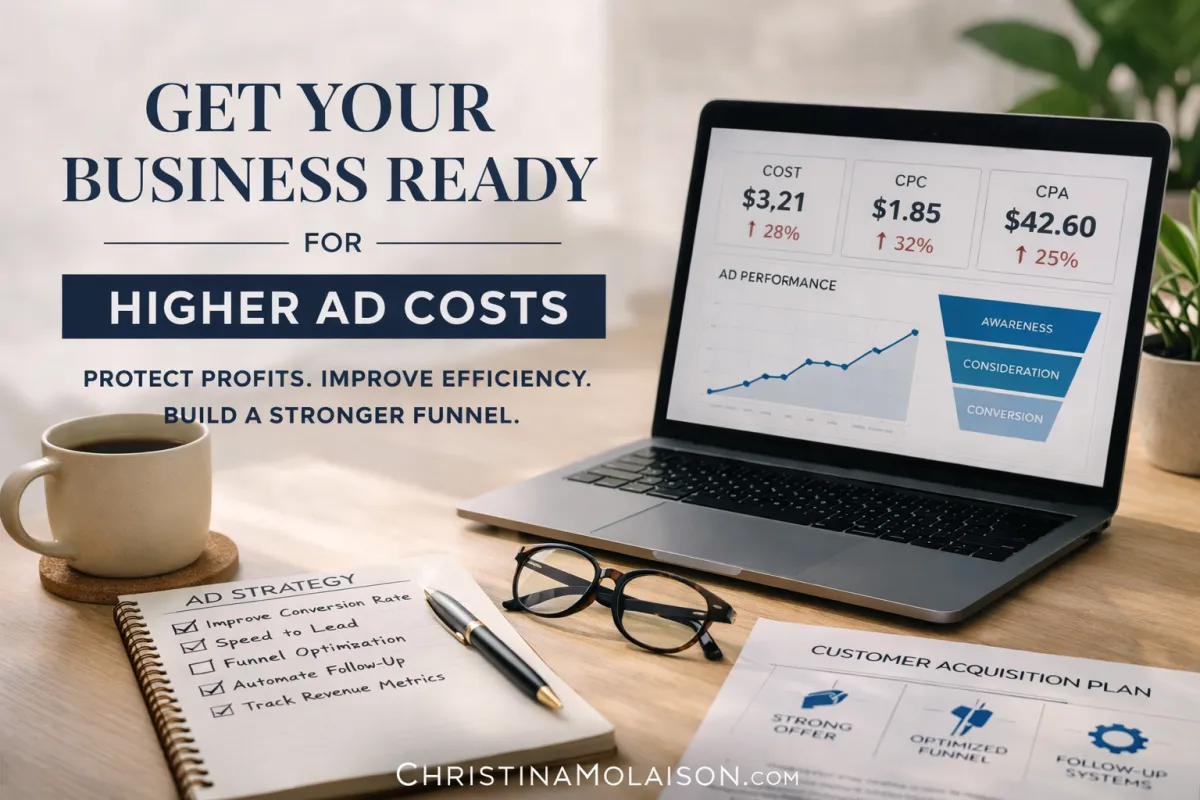
Get Your Business Ready for Higher Ad Costs
The headlines are clear: customer acquisition costs are rising. For small business owners, this financial pressure can feel like a storm gathering on the horizon. Every dollar spent on marketing now carries more weight, and the return on that investment feels more critical than ever. This external uncertainty quickly becomes an internal burden.
This pressure creates a cycle of reactive decision-making. You feel compelled to do more, be more visible, and try every new tactic, hoping something sticks. I learned this firsthand. When I launched my own insurance agency, there was no structure, and the constant chaos yielded no tangible results. The pressure to do more, without a clear plan, led to a mental breakdown. It taught me that stability must be built from the inside out.
The best defense against a volatile market is a stable, efficient business. The path to this stability involves intentional action and clear systems. It means developing a preference for new software and automation to boost efficiency, not to add another layer of complexity, but to create calm, control, and resilience from within.
The Real Threat of Rising Costs: More Than Just a Number
When ad costs go up, the immediate concern is financial. But the true danger is the ripple effect it has on your mental and operational health. The financial squeeze forces you into a state of constant reaction. You start making decisions based on short-term panic instead of long-term strategy. This is a fast track to burnout.
This reactive state is where chaos management becomes your full-time, unpaid job. You spend your days putting out fires, answering the same questions repeatedly, and manually piecing together customer information. The mental load of tracking every lead, every dollar, and every task becomes immense. You experience decision fatigue before you even sit down for lunch, and the thought, “my business is draining me,” becomes a constant echo.
This is how to avoid burnout as a business owner: you must recognize that the problem is not just the rising cost of ads. The problem is a lack of internal structure that can absorb external pressures. Without a solid foundation, any market shift can feel like a crisis. You end up working harder, not smarter, and your business starts to control your life instead of supporting it.
Stop Reacting, Start Building: Your Foundation for Stability
You cannot control global ad markets, platform algorithms, or economic trends. You can, however, control how your business operates. The ultimate solution is to shift your focus from what you cannot control to what you can: your internal systems, your workflows, and your capacity.
This begins with a commitment to clarity before growth. It is the principle that you must understand what you are doing, why you are doing it, and how it gets done before you try to scale. It is about building clarity and structure for sustainable growth, not just chasing vanity metrics. This approach is grounded in capacity-based decision making, which means you make choices that align with your actual time, energy, and resources.
To prepare for higher ad costs, small businesses should shift focus from external spending to internal efficiency. This involves establishing clarity on core business priorities, building simple structures to streamline operations, and adopting software and automation to reduce manual workload. This proactive approach creates financial resilience and reduces reactive stress.
Before you even think about new tools, you need a clear picture of your current reality. Here are the first steps to gaining that clarity:
Define Your Top 3 Priorities: What are the three most important outcomes for your business this quarter? Not the 20 tasks on your list, but the three core results. Write them down. Every decision should be filtered through them.
Map Your Core Workflow: How does a client go from a stranger to a happy customer? Draw it out, from first contact to final delivery. Identify every step, no matter how small.
Identify Your Biggest Time Sinks: Look at your workflow map. Where do you spend the most manual effort? What tasks are repetitive, tedious, and drain your energy? This is where you have the greatest opportunity for improvement.
Using Software and Automation to Boost Efficiency (and Sanity)
Once you have clarity on your priorities and workflows, you can strategically use technology to build a more resilient business. The goal is not to add more software to your plate. The goal is to use software and automation to boost efficiency in a way that reduces your workload and frees up your mental space.
Think of technology as your first employee, the one who happily takes on the boring, repetitive tasks that drain your energy. The rise of AI Adoption in Small Businesses has made this more accessible than ever. Smart tools can handle the administrative burden, allowing you to focus on the work only you can do: building relationships, creating your product, and steering the ship.
This is not about complex, enterprise-level systems. It is about finding simple, targeted solutions for your biggest time sinks. For example:
Automated Client Onboarding: Instead of manually sending welcome emails, contracts, and intake forms, you can create a system that triggers automatically when a new client signs up. This ensures a consistent, professional experience for every client without you lifting a finger.
AI-Powered Summaries: Imagine finishing a client call and immediately receiving a concise summary with key action items. AI tools can listen in, take notes, and distill the important information, saving you hours of administrative follow-up.
Streamlined Content Repurposing: Rather than manually reformatting a blog post for social media, email, and other platforms, tools can help you quickly adapt your core content for different channels, maximizing its reach with minimal effort.
By implementing smart software and automation to boost efficiency, you are not just saving time. You are creating predictability and stability. You are building a business that runs smoothly, with or without your constant, hands-on intervention.
Three Intentional Actions to Take This Week
Building a resilient business is a process of small, intentional steps. Here are three simple actions you can take this week to move from chaos to control.
Conduct a ‘Chaos Audit’. Block one hour in your calendar. Your only goal is to identify a single, repetitive task that consumes your time and energy. This could be anything from scheduling social media posts to following up on invoices. Acknowledging the source of the chaos is the first step in effective chaos management.
Define Your ‘Enough’ Metric. In a world that screams for more, decide what “enough” looks like for a successful week. This metric should go beyond revenue. It might be “work no more than 40 hours,” “onboard two new clients smoothly,” or “spend Friday afternoon completely offline.” This reclaims your definition of success.
Explore One Tool. Based on the task you identified in your chaos audit, spend 30 minutes researching one automation or AI tool designed to solve that specific problem. Do not buy anything. Just look. The goal is to see what is possible and to start shifting your mindset from doing everything yourself to finding smart support.
Frequently Asked Questions About Managing Business Overwhelm
How to get clarity in business?
To get clarity, start by defining your top three business priorities for the next 90 days. Next, map out your primary client workflow from start to finish. This process reveals what is essential and exposes inefficiencies, giving you a clear foundation for making strategic decisions instead of reactive ones.
What to do when you feel extremely overwhelmed?
When you feel extremely overwhelmed, stop and identify one small, completable task. Finishing something, no matter how minor, can break the paralysis. For a long-term solution, perform a ‘brain dump’ by writing down every single task and worry. Then, organize the list by priority to regain a sense of control.
How do solopreneurs avoid burnout?
Solopreneurs avoid burnout by setting firm boundaries and building simple systems. This includes defining work hours, automating repetitive administrative tasks, and saying no to opportunities that do not align with their core priorities. It is about matching your workload to your actual capacity, not a perceived ideal.
Why are small businesses suffering?
Many small businesses are suffering from a combination of external economic pressures and internal operational chaos. Rising costs and market uncertainty are difficult to manage without a strong foundation. A lack of clear systems leads to owner burnout, inefficient workflows, and an inability to adapt, making the business fragile.
From Financial Pressure to Financial Freedom
Rising ad costs are a reality, but they do not have to be a threat. They can be a catalyst, prompting you to build a stronger, leaner, and more intentional business. The pressure you feel is a signal that it is time to turn inward and fortify your foundation.
By focusing on clarity and structure for sustainable growth, you take back control. You build a business that is not dependent on unpredictable external factors but is instead powered by its own internal efficiency. This is how you reduce your mental load, make space for purposeful work, and create a business that truly supports the life you want to live. It is how you move from feeling drained by pressure to feeling empowered by your own design.